Introduction
Looking for a science experiment that feels a little bit like magic? Baking Soda Pines are the answer.
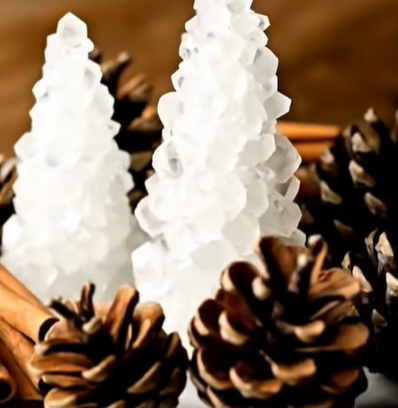
This activity transforms a common kitchen staple—sodium bicarbonate—into delicate, forest-like crystal structures overnight. It is a fantastic introduction to chemistry and geology for kids (and adults!), demonstrating exactly how stalagmites form in caves or how minerals crystallize in nature.
The process relies on evaporation. As water slowly leaves the solution, the baking soda molecules are forced out of the liquid. They bond together, stacking in specific geometric patterns to create jagged, tree-like “pine” structures that seem to grow out of nowhere.
Ingredients & Tools List
You don’t need a lab coat or expensive chemicals. Everything you need is likely already in your pantry.
The Solution
- 3–4 Tablespoons Baking Soda (Sodium Bicarbonate):
- Note: Ensure it is baking soda, not baking powder. They are chemically different.
- 1 Cup Water: Warm tap water is ideal.
- The Science: Warm water has higher kinetic energy, allowing it to dissolve more solute (baking soda) faster than cold water.
The Equipment
- Shallow Dishes: Small saucers, petri dishes, or foil-lined trays.
- Why Shallow? A large surface area speeds up evaporation, meaning your crystals grow faster.
- Spoon: For stirring.
- Food Coloring (Optional): If you want a “Green Forest” or “Pink Pines,” add a few drops to the liquid.
Sensory Note: This experiment is a visual one. The crystals are extremely fragile—like snowflakes—and will crumble if touched. They sparkle beautifully under a flashlight.
Timing
This is a lesson in patience. The “growing” happens while you sleep.
- Active Prep Time: 5 minutes
- Growth Time: 24–48 hours (Passive)
- Total Time: ~2 days
- Difficulty: Very Easy
Data Insight: The rate of evaporation depends on humidity. In a dry, warm room, you might see crystals forming in 12 hours. In a humid bathroom or rainy climate, it might take 3 days. Place your dishes near a sunny window or a heater vent for the fastest results.
Step-by-Step Instructions
Step 1: Create the Supersaturated Solution
- Pour 1 cup of warm water into a measuring cup or bowl.
- Add 3–4 tablespoons of baking soda.
- Stir vigorously for 1–2 minutes.
- The Goal: You want the water to be “cloudy.” If all the powder dissolves instantly and the water is clear, add another tablespoon. You want the water to hold as much baking soda as it possibly can (saturation).
Step 2: Pour the “Lake”
- Pour the cloudy liquid into your shallow dishes.
- Depth Matters: You only need a thin layer—about ¼ to ½ inch deep. If the liquid is too deep, it will take weeks to evaporate.
Step 3: The Wait (Evaporation)
- Place the dishes in a warm, dry spot where they will absolutely not be bumped.
- Suggestion: A windowsill, top of the fridge, or a bookshelf.
- Vibration Control: Crystallization requires stillness. If you bump the tray, you might disrupt the delicate lattice structure forming.
Step 4: Observation
- After 24 hours: You should see a white crust forming around the rim of the dish (the “shoreline”).
- After 48 hours: As the water level drops, jagged, needle-like structures will start growing upward and inward toward the center of the dish. These are your “Pines.”
The Science: What is Happening?
This is a classic example of Precipitation.
- Saturation: You filled the water with sodium bicarbonate molecules until there was no room for any more.
- Evaporation: As the water turns into gas and floats away, the volume of liquid decreases.
- Crystallization: The baking soda molecules that are left behind no longer have water molecules to hang onto. They are forced to bond with each other. Because sodium bicarbonate has a specific crystal lattice shape, they stack in jagged, repeating patterns that look like fern leaves or pine trees.
Variations for the Experiment
- The “Cave” Method (Stalactites):
- Place two jars of solution next to each other.
- Dip a piece of yarn or string so one end is in Jar A and the other in Jar B, with the middle draping down between them over a plate.
- Result: The liquid travels up the string via capillary action and drips onto the plate, forming a stalagmite tower over several days.
- Color Grading: Set up three small dishes. Add blue dye to one, yellow to another, and red to the third. Watch how the colored crystals look different from the pure white ones.
- Construction Paper Trees: Cut a tree shape out of cardboard or construction paper and stand it up in the liquid. The crystals will “climb” the paper (capillary action) and bloom on the branches.
Common Mistakes to Avoid
- Too Much Water:
- The Issue: Filling a deep bowl.
- The Result: It takes too long to evaporate, and mold might grow before crystals do.
- The Fix: Stick to shallow saucers.
- Moving the Dish:
- The Issue: Checking it constantly.
- The Result: The crystals break and fall back into the sludge.
- The Fix: Hands off! Look with your eyes, not your fingers.
- Using Baking Powder:
- The Issue: Wrong ingredient.
- The Result: A fizzy, pasty mess with no crystals. Baking powder contains acid and cornstarch, which interferes with crystal formation.
Conclusion
Baking Soda Pines are a wonderful reminder that science is happening all around us, even in a puddle of drying water. It turns a boring afternoon into a geology lesson and rewards patience with beautiful, sparkling structures.
Leave a Reply