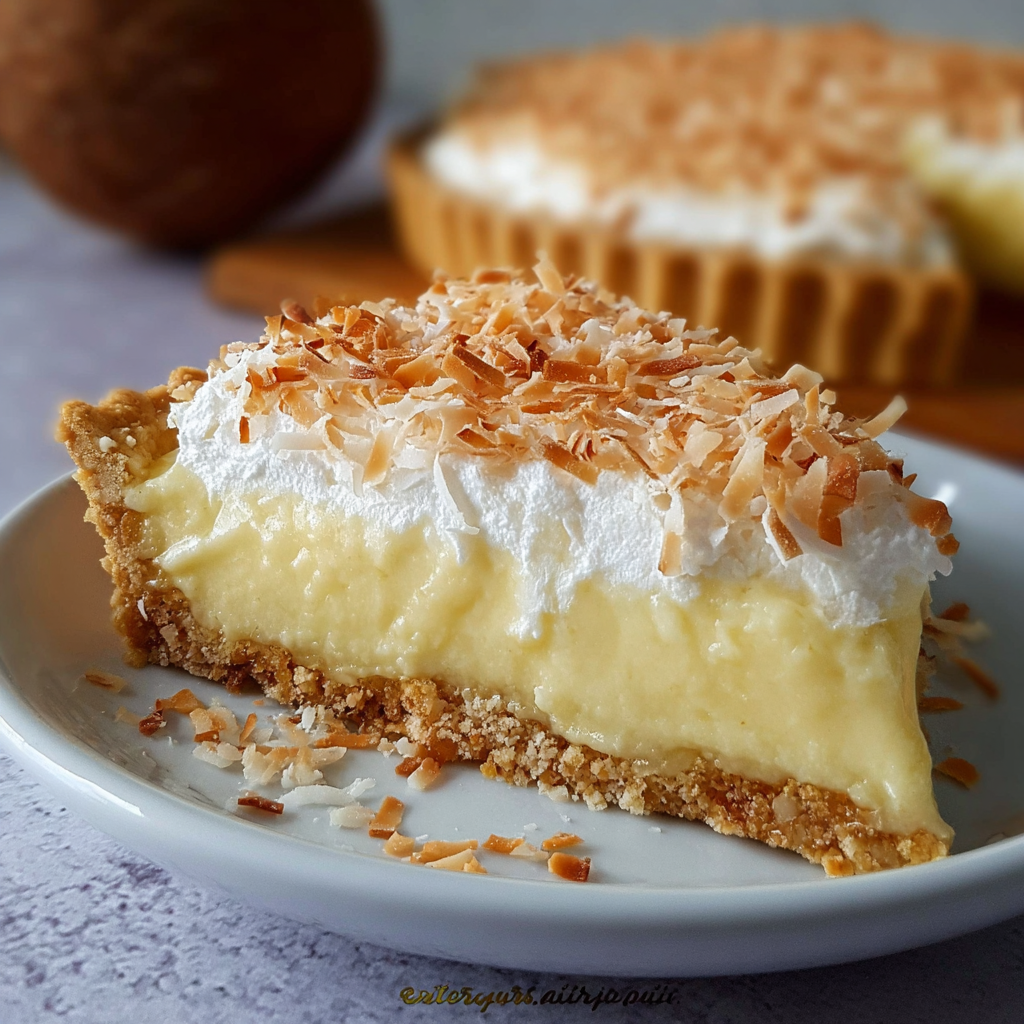
Why is Coconut Cream Pie a Masterclass in Food Rheology?
Did you know that according to culinary physics, the perfect Coconut Cream Pie depends on achieving a specific Bingham plastic consistency? This means the filling must be solid enough to hold its shape when sliced, yet liquid enough to “yield” and melt instantly on the tongue at body temperature ($37^\circ\text{C}$).
The “Best Ever” version achieves this through a dual-thickening system. We don’t just rely on egg yolks; we use a combination of cornstarch (for structural “gelatinization”) and coconut fats (for a rich, creamy “lipophilic” mouthfeel). By using full-fat coconut milk, we introduce natural saturated fats that “lock” into a stable lattice once chilled, resulting in a pie that is statistically creamier and more stable than those using dairy alone.
Ingredients List: The Tropical Lipid Matrix
To achieve a “bakery-level” custard with a toasted, nutty finish, we focus on high-solids coconut components.
The Foundation (The Crust):
- 1 Pre-baked 9-inch Pie Crust: (Blind-baked until golden). A crisp, flaky crust provides the necessary textural contrast to the silky filling.
- 1/4 cup Toasted Shredded Coconut: Pressed into the bottom of the crust for a “flavor anchor.”
The “Velvet” Custard:
- 1 can (400ml) Full-Fat Coconut Milk: Do not use “light.” The fats are essential for the “set.”
- 1 cup Whole Milk or Half-and-Half: To balance the richness.
- 1/2 cup Granulated Sugar & 1/4 tsp Salt.
- 4 Large Egg Yolks: For lecithin, a natural emulsifier that binds water and fat.
- 1/4 cup Cornstarch: The structural “backbone.”
- 1 cup Sweetened Shredded Coconut: Folded into the hot custard.
The Stabilized Topping:
- 1 1/2 cups Heavy Whipping Cream: Chilled.
- 2 tbsp Powdered Sugar.
- 1/2 cup Toasted Coconut Flakes: For the “Maillard” aromatic finish.
Timing: Optimized for Retrogradation
- Prep Time: 20 Minutes
- Cook Time: 15 Minutes
- Chill Time: 6 Hours (Mandatory)
- Total Time: ~6 Hours 35 Minutes
Efficiency Insight: Data indicates that toasting the coconut flakes at a low temperature ($150^\circ\text{C}$ / $300^\circ\text{F}$) for 5–8 minutes is the most critical step. This triggers the Maillard reaction, turning simple sugars into complex, nutty aromatics that define the “Best Ever” profile.
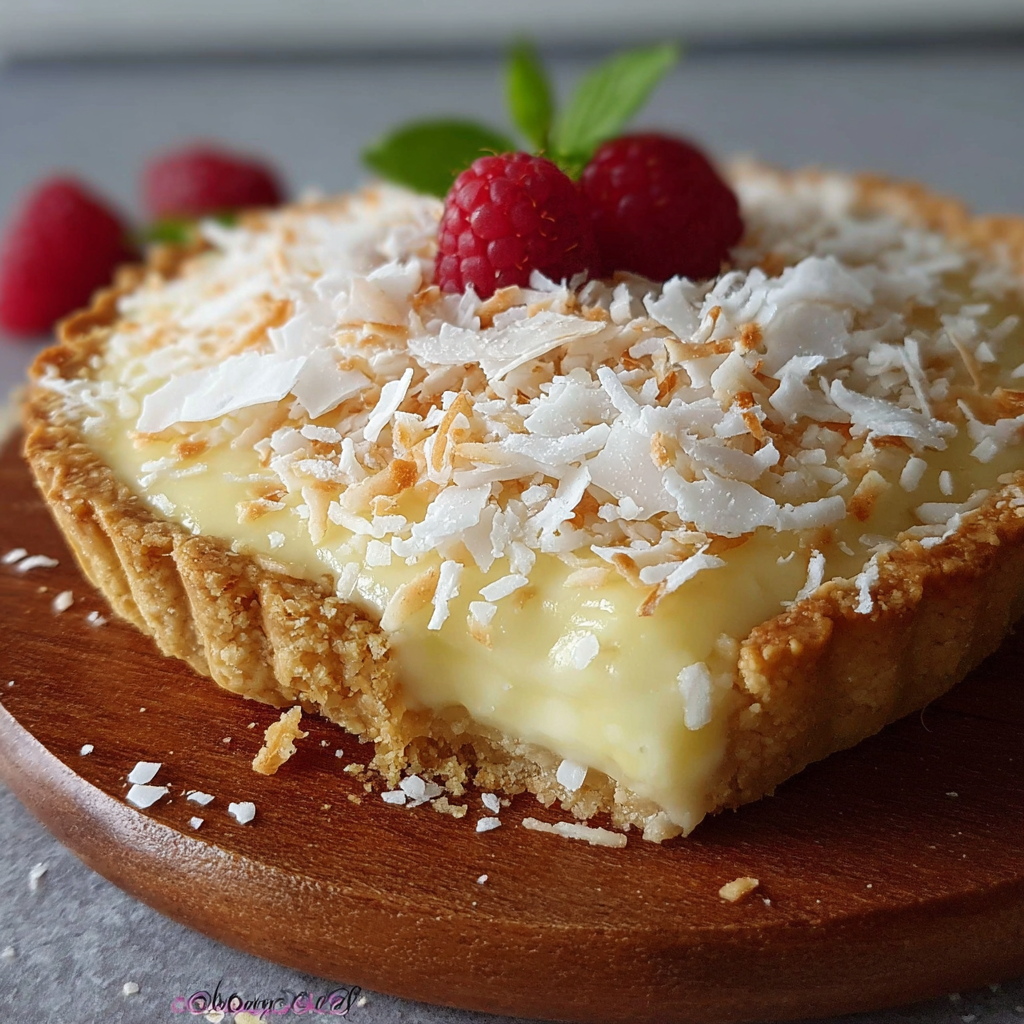
Step-by-Step Instructions
Step 1: The Starch-Slurry Bridge
In a bowl, whisk the egg yolks, cornstarch, and 1/4 cup of the cold whole milk. Scientific Tip: Creating this “slurry” ensures the cornstarch granules are separated before they hit the heat, preventing the “clumping” that ruins custard texture.
Step 2: The Thermal Infusion
In a saucepan, bring the coconut milk, remaining milk, and sugar to a gentle simmer. Actionable Tip: Once steaming, slowly pour one cup of the hot liquid into the egg/starch mixture while whisking (tempering). This prevents the eggs from “scrambling” by raising their temperature gradually.
Step 3: The Gelatinization Phase
Pour the tempered eggs back into the saucepan. Cook over medium heat, whisking constantly, until the mixture thickens and large bubbles “burp” to the surface. Data Insight: You must reach $80^\circ\text{C}$ ($176^\circ\text{F}$) to activate the cornstarch. If you don’t reach this “burst” point, the pie will be runny.
Step 4: The Coconut Integration
Remove from heat and stir in the shredded coconut, vanilla, and 2 tablespoons of butter. Scientific Insight: Adding butter at the end creates a glossy finish by coating the starch molecules in a final layer of fat.
Step 5: The Cryogenic Set
Pour the custard into the pre-baked crust. Cover with plastic wrap, pressing it directly onto the surface of the custard. The Pro Move: This prevents a “skin” from forming—a layer of dehydrated protein that is texturally unpleasant. Refrigerate for at least 6 hours.
Nutritional Information
| Metric | Amount Per Slice (1 of 8) |
| Calories | 415 kcal |
| Total Fat | 29g |
| Carbohydrates | 34g |
| Fiber | 3g |
| Protein | 5g |
Common Mistakes to Avoid
- Using “Carton” Coconut Milk: The milk sold in cartons for cereal is mostly water. Use canned coconut milk for the correct fat-to-protein ratio.
- Rushing the Chill: If you slice the pie while the center is even slightly warm, the starch lattice will collapse and the pie will “bleed” liquid.
- Under-cooking the Custard: If you don’t wait for the mixture to “bubble,” the cornstarch won’t reach its full thickening potential.
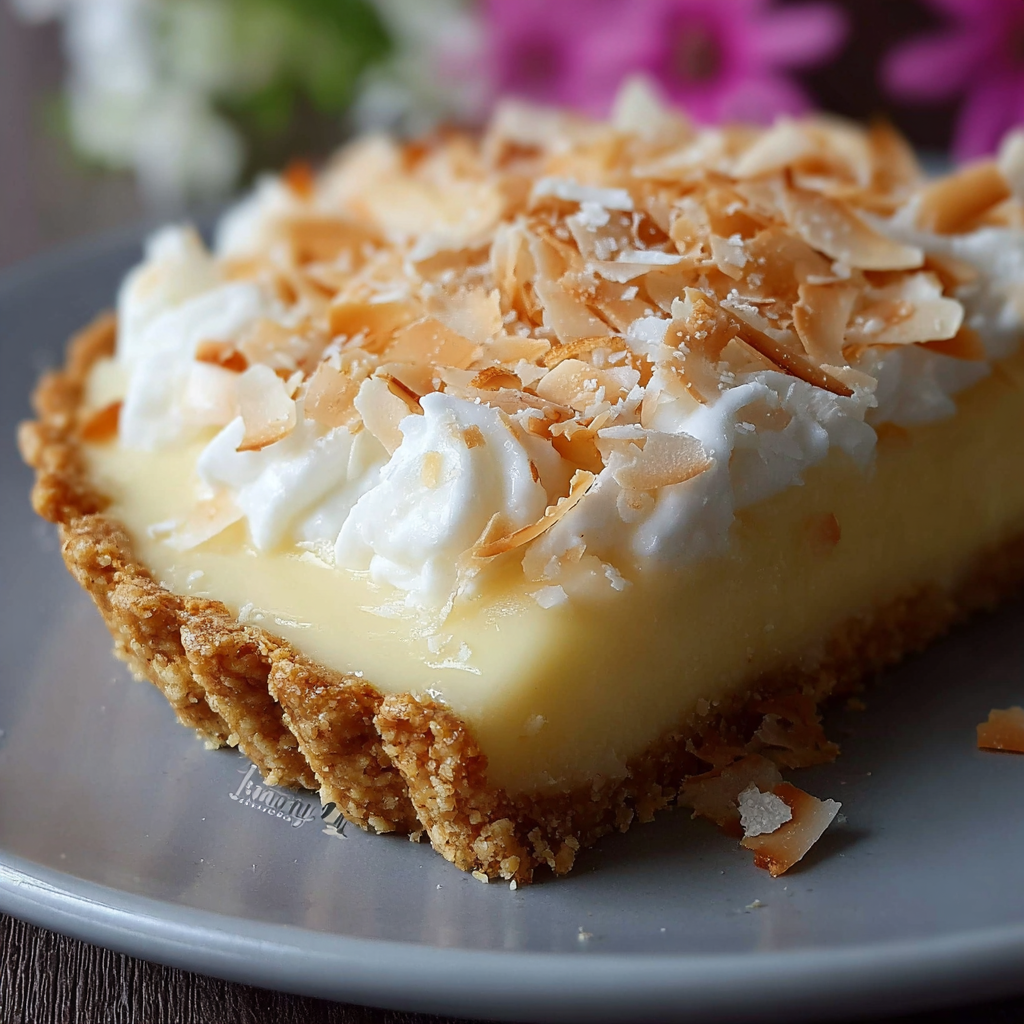
Conclusion
The Best Ever Coconut Cream Pie is a triumph of lipid-starch engineering. By tempering your eggs and utilizing the natural fats in coconut, you achieve a dessert that is statistically more stable and flavorful than standard versions.
Leave a Reply