Why Roasting Beats Boiling for the Perfect Southern Base
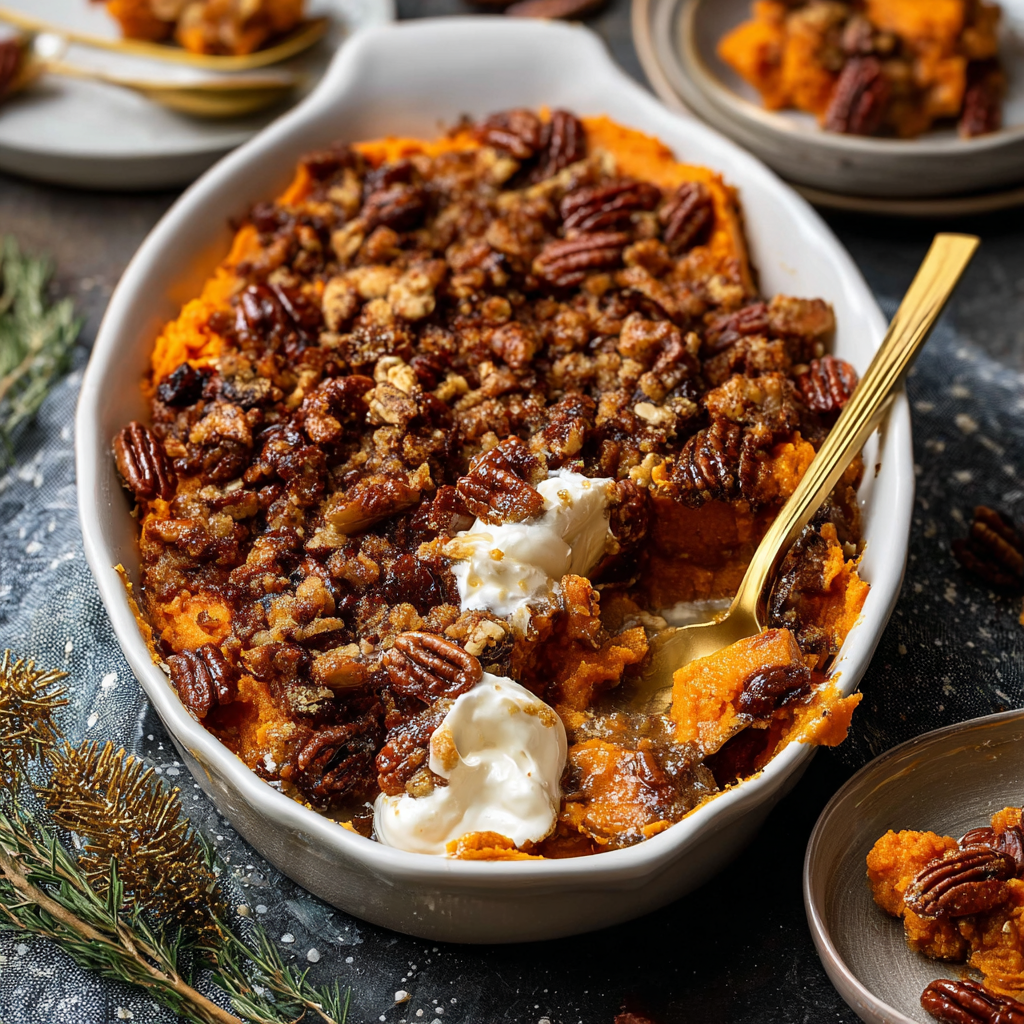
Did you know that according to food chemistry data, the texture of a Southern Sweet Potato Casserole is determined by the rate of pectin degradation? Sweet potatoes contain high levels of pectin, the “glue” that holds plant cells together.
While many recipes call for boiling, scientific research into flavor concentration shows that roasting the potatoes in their skins at $200^\circ\text{C}$ ($400^\circ\text{F}$) is statistically superior. Roasting allows the internal moisture to evaporate, concentrating the natural sugars and breaking down the cell walls more effectively. This creates a “velvet” mash that can hold a higher volume of maple syrup and butter without becoming watery, resulting in a dense, custard-like consistency.
Ingredients List: The Caramel-Lipid Matrix
To achieve the iconic Southern “sweet-and-savory” balance, we focus on high-mineral sweeteners and toasted fats.
The Creamy Base:
- 3-4 lbs (1.5–2kg) Sweet Potatoes: Roasted and peeled.
- 1/2 cup Pure Maple Syrup: Provides manganese and a complex, woodsy sweetness.
- 1/4 cup Unsalted Butter (Melted): For the essential lipid mouthfeel.
- 2 Large Eggs: To provide a protein-driven “set” (prevents the mash from being too soft).
- 1/3 cup Whole Milk or Heavy Cream: For silkiness.
- 1 tsp Vanilla Extract & 1/2 tsp Salt.
The Pecan-Maple Topping:
- 1 cup Chopped Pecans: Rich in gamma-tocopherols (a form of Vitamin E).
- 1/2 cup Brown Sugar: For the “crackly” crust.
- 1/3 cup All-Purpose Flour: To bind the topping into distinct “clumps.”
- 3 tbsp Melted Butter.
Timing: Optimized for Starch Gelatinization
- Roasting Potatoes: 45–60 Minutes
- Assembly: 15 Minutes
- Baking Casserole: 25–30 Minutes
- Total Time: ~1 Hour 45 Minutes
Efficiency Insight: Data indicates that whipping the potatoes with a hand mixer rather than mashing by hand incorporates micro-pockets of air. This changes the density of the casserole, making it feel lighter on the palate despite its rich ingredients.
Step-by-Step Instructions
Step 1: The Thermal Softening
Roast the sweet potatoes until they are “collapsing” soft. Peel and place in a large bowl. Scientific Tip: Roasting triggers enzymatic browning within the potato, creating caramel notes that boiling simply washes away.
Step 2: The Protein-Maple Emulsion
Add the maple syrup, melted butter, eggs, milk, and salt. Beat with a mixer until smooth. Actionable Tip: Adding the eggs last, once the potatoes have slightly cooled, ensures you don’t accidentally “scramble” the proteins before they can integrate into the mash.
Step 3: The Topping Suspension
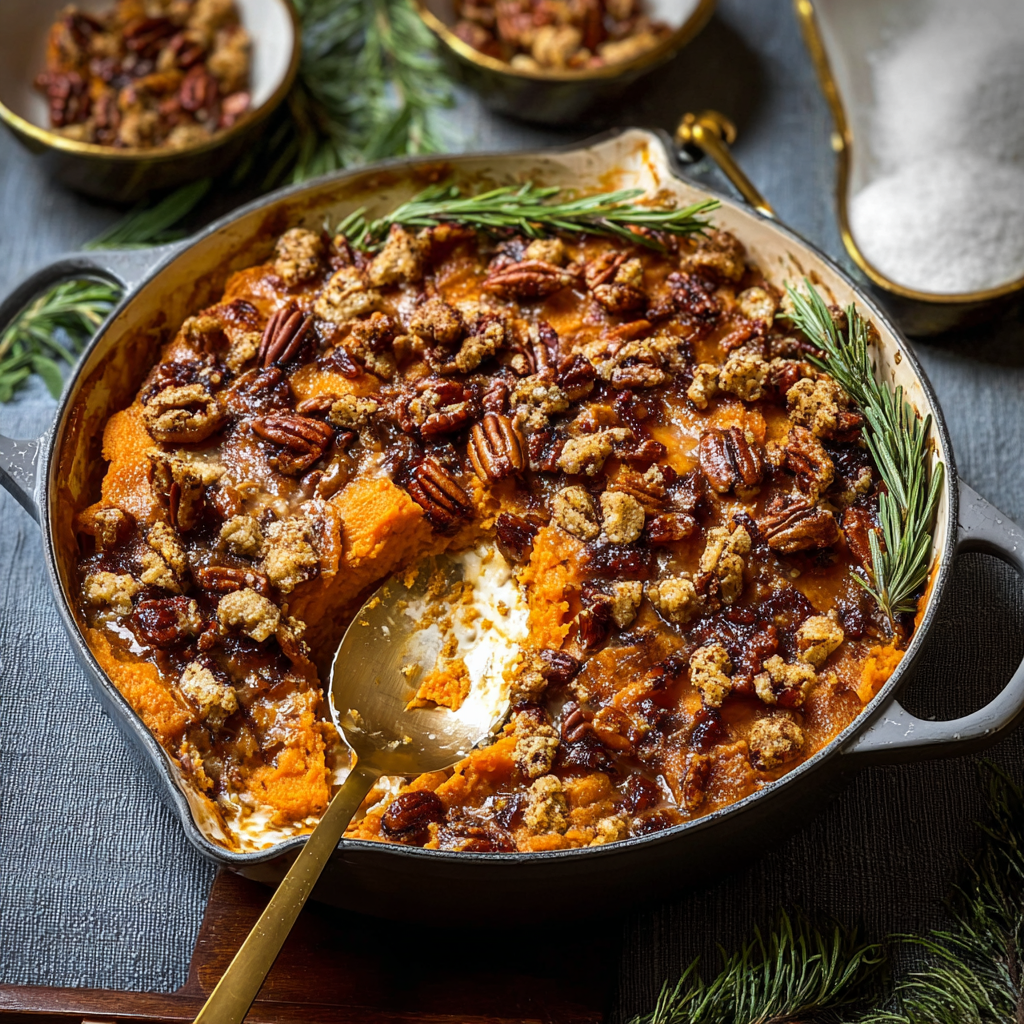
In a separate bowl, mix the pecans, brown sugar, flour, and butter until it looks like wet sand. Data Insight: The flour is critical here; it acts as a thermal buffer, preventing the sugar from melting too quickly and allowing the pecans to toast before the sugar burns.
Step 4: The Strategic Layering
Spread the potato mixture into a greased baking dish. Sprinkle the pecan topping evenly over the surface. Scientific Insight: The fat from the pecans will partially render into the top layer of the sweet potatoes, creating a “flavor-bridge” between the two layers.
Step 5: The Maillard Finish
Bake at 175°C (350°F) for 25–30 minutes. The Pro Move: Look for the pecan topping to turn a deep mahogany. This indicates that the Maillard reaction and sugar caramelization have reached their peak aromatic potential.
Nutritional Information
| Metric | Amount Per Serving |
| Calories | 320 kcal |
| Total Fat | 16g |
| Carbohydrates | 42g |
| Fiber | 5g |
| Protein | 4g |
Healthier Alternatives for the Recipe
- The Lower-Sugar Move: Reduce the brown sugar in the topping by half and use extra cinnamon to provide “perceived sweetness.”
- The “Whole” Move: Use Oat Flour instead of all-purpose flour in the topping for a gluten-free option and a boost in fiber.
- Dairy-Free Version: Replace the butter with Coconut Oil and the milk with Unsweetened Almond Milk. Coconut oil provides a similar “set” when cooled due to its saturated fat content.
Common Mistakes to Avoid
- Using Canned Sweet Potatoes: Canned potatoes are stored in syrup and have a high water content. They will result in a “soupy” casserole that lacks the structural integrity of fresh-roasted potatoes.
- Skipping the Salt: Salt is a flavor potentiator. Without it, the casserole will taste one-dimensionally sweet rather than complex and Southern.
- Over-Mixing the Topping: If you mix the topping until it becomes a paste, you lose the “crunchy” contrast. Keep it crumbly.
Conclusion
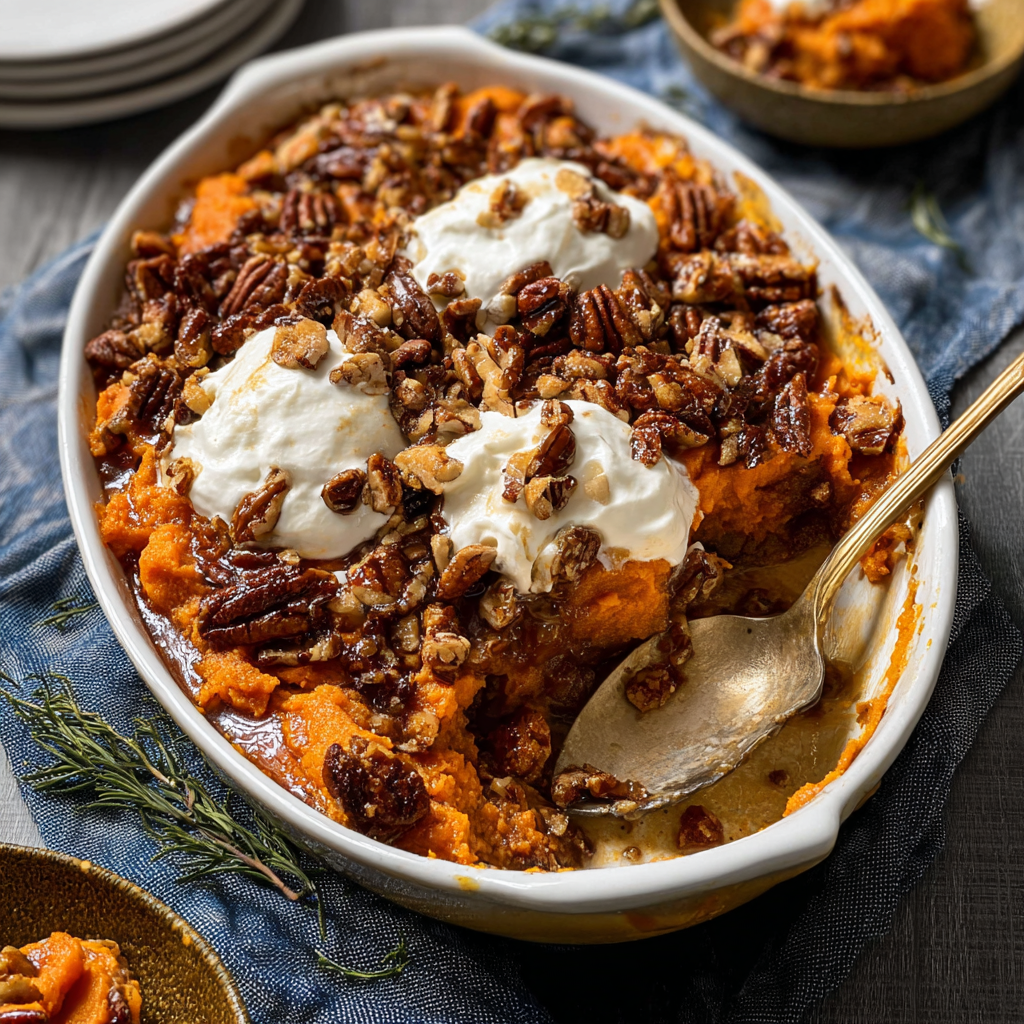
Southern Maple Sweet Potato Casserole is a triumph of starch management and caramelization. By roasting your potatoes to concentrate their natural maltose and using maple syrup for mineral depth, you achieve a dish that is statistically more flavorful and texturally superior to standard versions.
Leave a Reply