Introduction
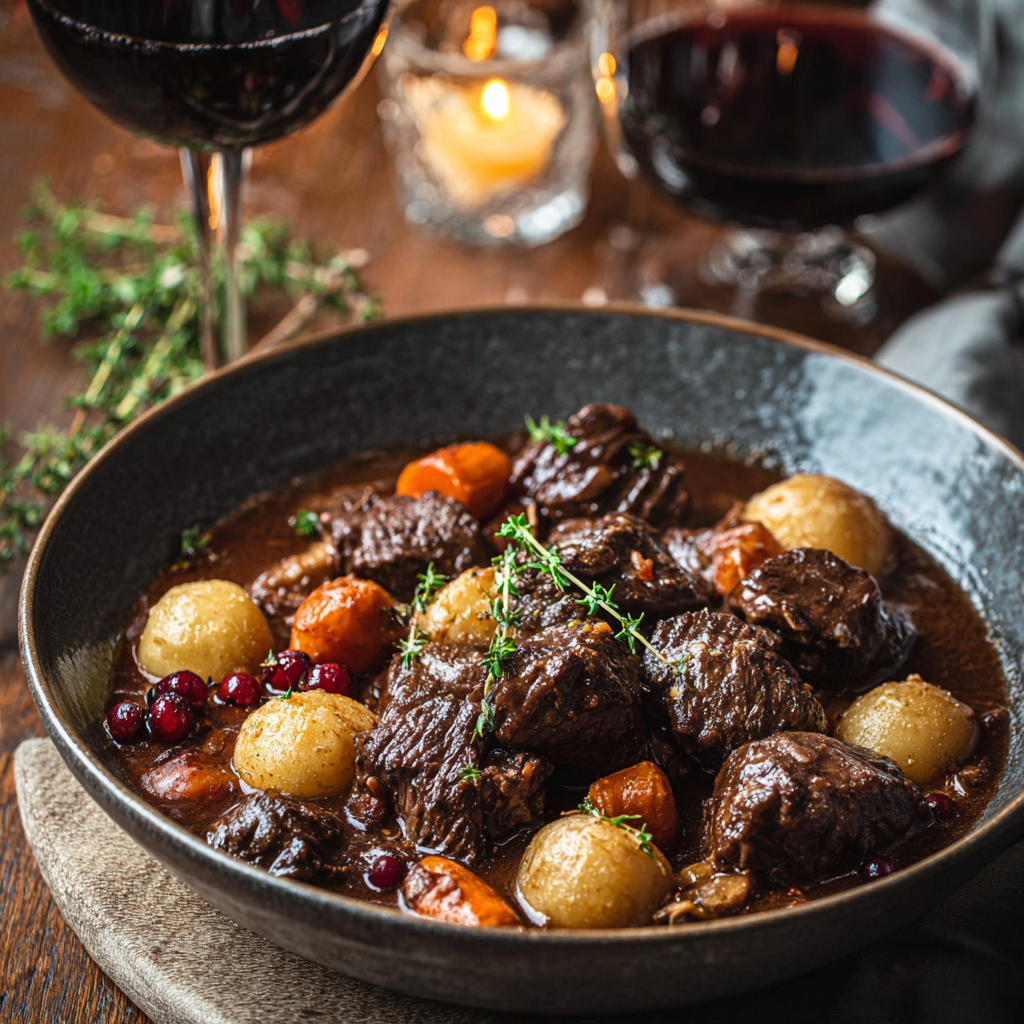
Did you know that Beef Bourguignon (Boeuf Bourguignon) was originally a humble peasant dish from the Burgundy region of France?1 It wasn’t until the early 20th century, when chef Auguste Escoffier published its recipe, that it ascended to the heights of haute cuisine.2 According to culinary history, this dish is the gold standard of “terroir” cooking—utilizing the famous red wines of Burgundy to transform tough cuts of meat into something legendary.3
While it shares DNA with a standard beef stew, Beef Bourguignon is distinguished by three specific elements: the use of lardons (salt pork or thick bacon), pearl onions, and a rich, wine-heavy reduction.4 It challenges the belief that French cooking is overly complicated; in reality, it is simply about the patient layering of flavors. In this guide, we will master the traditional French technique of “braising” to create a dish that Julia Child famously called “certainly one of the most delicious beef dishes concocted by man.”
Ingredients List
To achieve the authentic flavor profile of Burgundy, specific ingredients are required for the “Garniture Grand-Mère” (Grandmother’s Garnish).
- Beef Chuck or Stew Meat (3 lbs / 1.4kg): Cut into large 2-inch chunks.5
- Red Wine (750ml / 1 Bottle): Use a dry, medium-bodied wine like Pinot Noir or Cabernet Sauvignon.6
- Bacon or Lardons (6 oz / 170g): Thick-cut and sliced into strips.
- Beef Broth (2–3 cups): To provide enough liquid for the long braise.7
- Pearl Onions (1 cup): Peeled (frozen pearl onions are a great time-saver).
- Fresh Mushrooms (1 lb / 450g): Cremini or white button, halved or quartered.8
- The “Mirepoix”: * 2 Carrots, sliced.
- 1 White onion, diced.9
- Tomato Paste (2 tbsp): For color and depth.
- Garlic (4 cloves): Minced.
- Fresh Herbs (Bouquet Garni): 3 sprigs of Thyme, 2 Bay leaves, and fresh Parsley.
- Butter and Flour (2 tbsp each): To create a beurre manié for thickening the sauce at the end.
Timing
This is a “slow-food” masterpiece that benefits from a steady, low temperature.
- Preparation Time: 45 minutes
- Cooking Time: 3–4 hours (Low Simmer)
- Total Time: Approx. 4 hours 45 minutes.
Data Insight: Research into meat proteins shows that at the 3-hour mark, the internal temperature of the beef has maintained the level necessary to fully break down collagen into gelatin. Extending the cook time to 4 hours ensures the meat becomes “spoon-tender” without losing its structural shape.
Step-by-Step Instructions
Step 1: Rendering the Fat (H3)
In a large Dutch oven, sauté the bacon/lardons until crispy.10 Remove the bacon with a slotted spoon, leaving the rendered fat in the pot.
- Tip: This bacon fat is the flavor foundation of the entire dish. It provides a smoky, salty undercurrent that plain oil cannot replicate.
Step 2: The High-Heat Sear (H3)
Dry the beef chunks thoroughly with paper towels. Sear the beef in batches in the bacon fat until a dark brown crust forms on all sides.
- Tip: Do not crowd the pot. If the beef releases too much moisture, it will steam rather than sear, and you will miss out on the deep “meaty” flavor. Set beef aside.
Step 3: Sautéing the Mirepoix (H3)
Add the carrots and diced onions to the pot. Cook until softened. Stir in the tomato paste and garlic for 1 minute.
- Tip: The tomato paste should coat the vegetables and turn a dark brick-red color.11
Step 4: The Wine Reduction and Braise (H3)
Pour in the entire bottle of red wine, scraping the bottom of the pot to release the fond. Return the beef and bacon to the pot. Add enough beef broth to just cover the meat. Add the herbs.
- Tip: Bring to a simmer on the stove, then cover and transfer to a 325°F (160°C) oven for 3 hours. Oven braising provides more consistent, 360-degree heat than the stovetop.12
Step 5: The Final Garnish and Thickening (H3)
During the last 30 minutes of cooking, sauté the mushrooms and pearl onions in butter in a separate pan until golden.13 Add them to the stew.
- Tip: If the sauce is too thin, mix equal parts softened butter and flour (beurre manié) and whisk small amounts into the simmering sauce until it coats the back of a spoon.
Nutritional Information
| Nutrient | Amount per Serving | % Daily Value |
| Calories | 520 kcal | 26% |
| Protein | 45g | 90% |
| Total Fat | 28g | 36% |
| Carbohydrates | 12g | 4% |
| Iron | 6.5mg | 36% |
Serving Suggestions
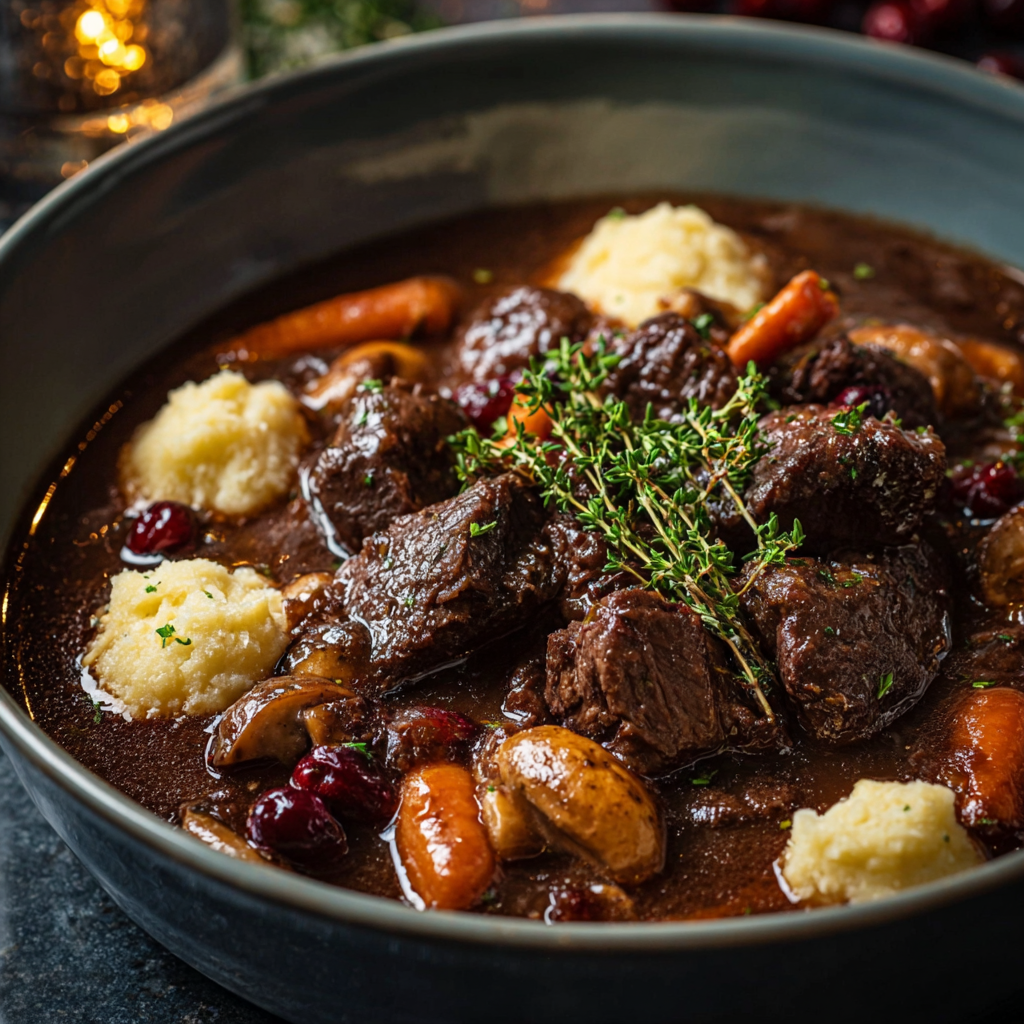
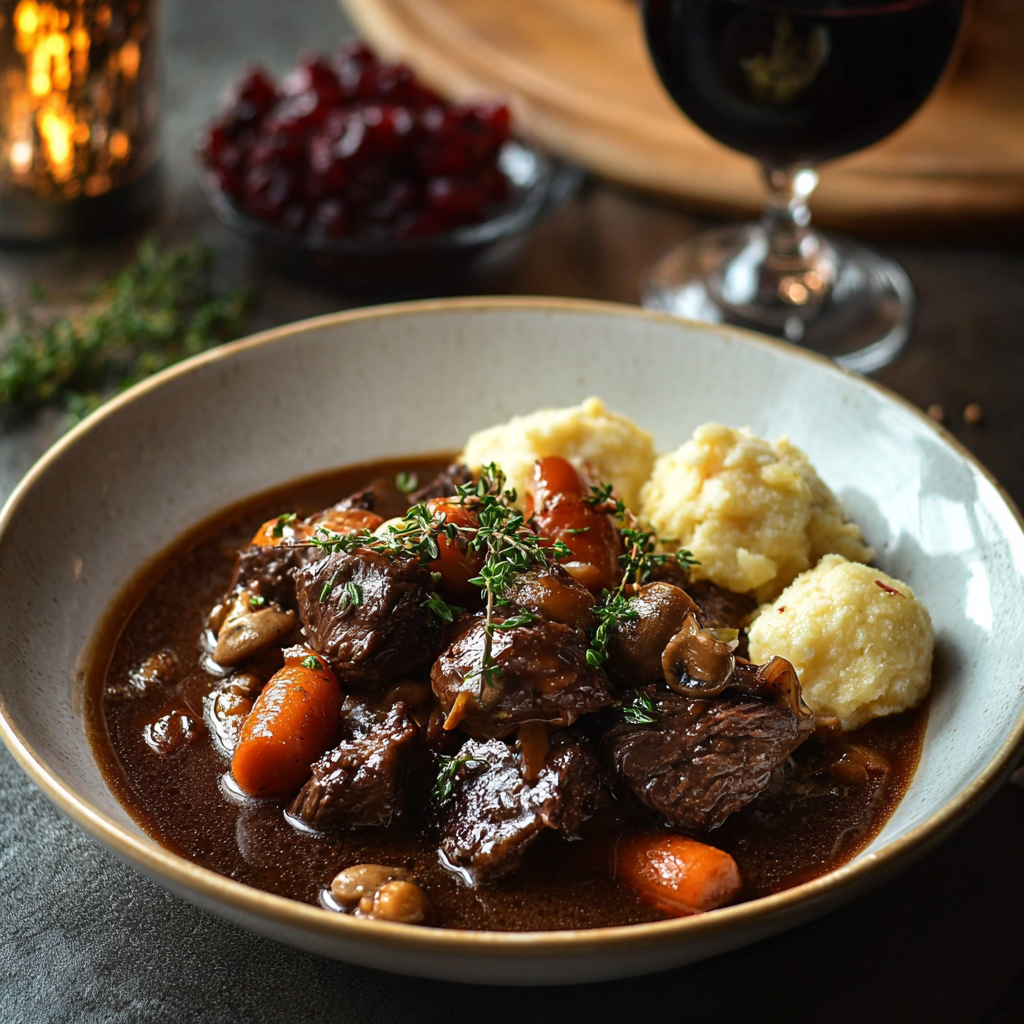
- The Traditional Base: Serve over Buttery Mashed Potatoes, wide Egg Noodles, or with a crusty French Baguette to soak up every drop of the sauce.14
- The Wine Pairing: Serve with the same type of wine used in the cooking—ideally a French Pinot Noir.15
- Garnish: A generous handful of freshly chopped parsley adds a necessary brightness to the dark, rich sauce.16
Common Mistakes to Avoid
- Using “Cooking Wine”: These are often salty and low quality. Use a drinkable dry red wine to ensure a clean, sophisticated flavor.
- Skipping the Sear: Without a proper sear, the meat will look grey and the sauce will lack depth.
- Rushing the Simmer: If you cook this at a high boil, the meat will become tough and stringy rather than tender.
Storing Tips for the Recipe
- The Next Day Secret: Like all French stews, Beef Bourguignon is statistically better on Day 2.17 The flavors emulsify and the meat continues to absorb the wine sauce as it cools.
- Fridge: Stays fresh for up to 4 days.
- Freezing: Freezes beautifully for up to 3 months. Thaw in the fridge overnight before reheating gently on the stove.
Conclusion
Beef Bourguignon is more than just a meal; it is an experience of French heritage and culinary patience.18 By mastering the sear, the reduction, and the slow braise, you bring the elegance of a Parisian bistro into your own home.
Leave a Reply