Introduction
Most people cook scrambled eggs wrong.
If your eggs are rubbery, dry, or browned, you are cooking them too fast. The secret to The Best Scrambled Eggs—the kind served in high-end Parisian bistros—isn’t a fancy ingredient; it is temperature control.
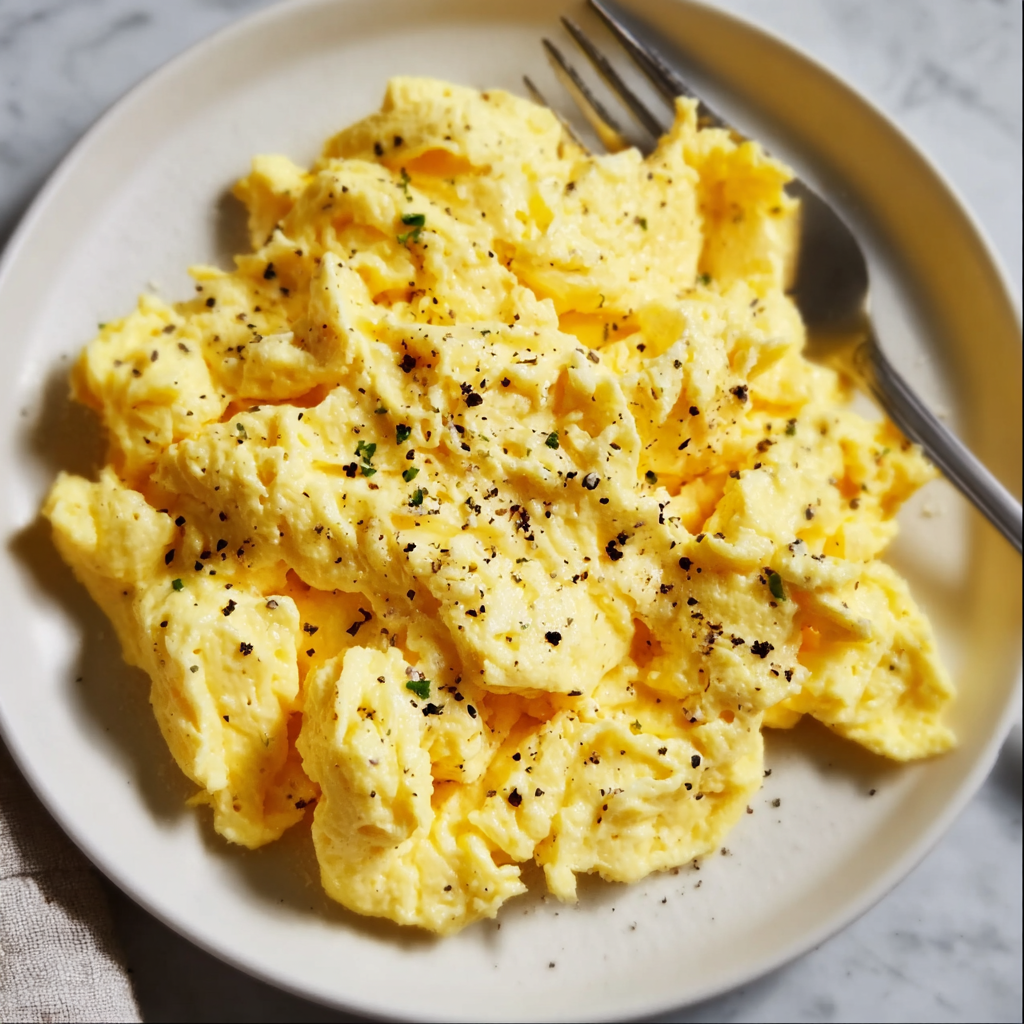
By cooking the eggs over incredibly low heat and stirring constantly, you prevent the proteins from seizing up into hard curds. Instead, they form a soft, custard-like emulsion that is creamy, rich, and barely holds its shape on the plate. It is less like a “scramble” and more like an “egg risotto.” Once you try this method, you will never go back to the high-heat, dry-pan method again.
Ingredients List
Because this recipe relies on technique, the quality of the few ingredients matters.
- 3 Large Eggs: The fresher, the better. Fresh eggs have tighter whites that emulsify creamier.
- 1 tbsp Unsalted Butter: Divided (½ tbsp for the pan, ½ tbsp for the finish).
- The Finish: Adding cold butter at the very end stops the cooking process and adds a glossy sheen.
- 1 tsp Crème Fraîche: (Or Sour Cream/Heavy Cream).
- The Secret Weapon: This adds a final tang and luxurious texture that butter alone cannot achieve.
- Salt: Fine sea salt.
- Fresh Chives: Finely chopped, for garnish.
- Black Pepper: Freshly cracked.
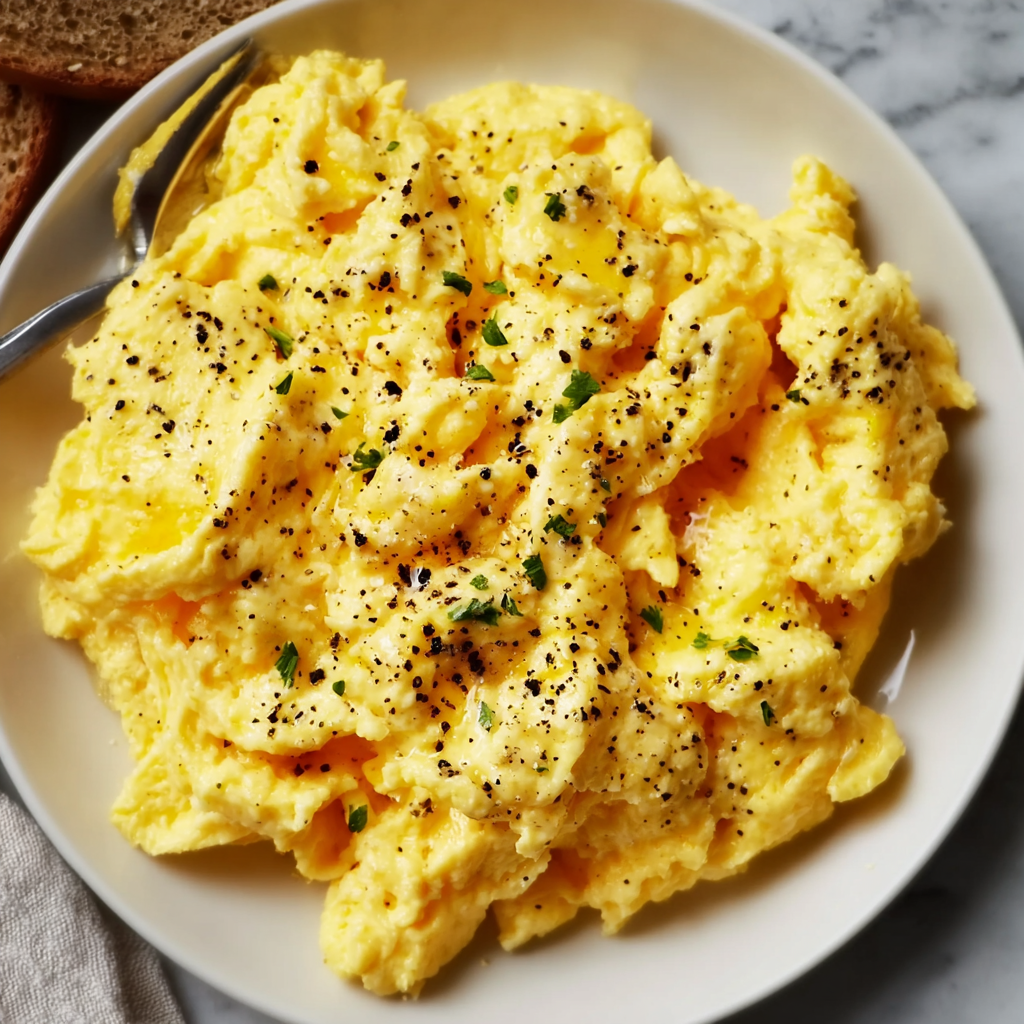
Sensory Note: The texture should be velvety and moist, with no “weeping” water on the plate. The flavor is pure, intense butter and egg, with the chives cutting through the richness.
Timing
Patience is the only difficult part of this recipe.
- Prep Time: 2 minutes
- Cook Time: 5–10 minutes (Yes, really)
- Total Time: ~12 minutes
- Serves: 1 person
Data Insight: Egg proteins begin to coagulate at $140^\circ F$ ($60^\circ C$) and become tough/rubbery at $180^\circ F$ ($82^\circ C$). By cooking “low and slow,” we keep the eggs in that sweet spot between $145^\circ F$ and $165^\circ F$ for longer, ensuring maximum creaminess.
Step-by-Step Instructions
Step 1: The Cold Start
- Crack the eggs directly into a cold non-stick saucepan (or skillet).
- Add ½ tbsp of butter.
- Do not whisk yet. Do not add salt yet (salt breaks down proteins prematurely, making them watery if added too early).
Step 2: The Low Heat Stir
- Place the pan over Medium-Low heat.
- Using a flexible rubber spatula, start stirring immediately.
- The Motion: Stir in small circles, constantly scraping the bottom and sides of the pan. You want to break the yolks and mix them with the butter as it melts.
Step 3: The “On and Off” Technique
- As the pan heats up and curds start to form (around minute 2 or 3), you must control the heat.
- Pull it off: If the eggs start cooking too fast (sticking to the bottom), remove the pan from the heat for 20 seconds while continuing to stir.
- Put it back: Return to the heat for 30 seconds.
- Repeat this “on-and-off” dance until the eggs look like soft porridge or loose curds. They should still look slightly “wet.”
Step 4: The Arrest
- When the eggs are 90% done (they look slightly undercooked to the eye), remove from heat permanently. Residual heat will finish them.
- Stir in the remaining ½ tbsp cold butter and the crème fraîche.
- Why? The cold fat drops the temperature of the eggs instantly, preventing them from overcooking in the pan.
Step 5: Season and Serve
- Now season with salt and pepper.
- Spoon onto a plate (or a slice of buttered sourdough toast).
- Sprinkle generously with fresh chives.
Nutritional Information
A high-fat, high-protein breakfast. Below is the estimated breakdown.
| Nutrient | Amount per Serving | % Daily Value* |
| Calories | 320 kcal | 16% |
| Total Fat | 26g | 40% |
| Saturated Fat | 14g | 70% |
| Cholesterol | 580mg | 193% |
| Protein | 19g | 38% |
| Carbohydrates | 2g | 1% |
Variations for the Recipe
- The American Fluff: If you prefer large, fluffy curds (diner style), use medium-high heat and push the eggs gently with a spatula rather than stirring constantly. Add a splash of water (not milk) to the raw eggs to create steam for fluffiness.
- Cheesy: Stir in grated Gruyère or Parmesan at Step 4.
- Truffle: Drizzle with white truffle oil just before serving.
- Spicy: Add a dash of hot sauce or chili crisp at the end.
Serving Suggestions
- The Bread: These eggs are soft, so they need a crunchy partner. Thick Sourdough Toast or a toasted English Muffin is essential.
- The Side: Smoked Salmon or Avocado slices pair beautifully with the creamy texture.
Common Mistakes to Avoid
- High Heat:
- The Issue: Trying to cook eggs in 1 minute.
- The Result: Dry, rubbery nuggets.
- The Fix: Turn the heat down. If the pan sizzles, it’s too hot.
- Stopping the Stir:
- The Issue: Walking away.
- The Result: An omelet layer forms on the bottom.
- The Fix: Never stop moving the spatula.
- Salting Too Early:
- The Issue: Salting raw eggs in the bowl 10 minutes prior.
- The Result: The eggs turn greyish and watery.
- The Fix: Salt at the very end.
Storing Tips for the Recipe
- Don’t: Scrambled eggs do not reheat well. They emit a sulfur smell and become rubbery. Make them fresh.
- If you must: Store in the fridge for 1 day. Reheat gently in the microwave (10 seconds) with a damp paper towel on top to steam them.
Conclusion
The Best Scrambled Eggs require a shift in mindset. You aren’t just heating food; you are managing a delicate protein structure. The result is a breakfast that feels luxurious and comforting, elevating the humble egg into a masterpiece.
Ready to stir? Grab your spatula! If you try this method, please leave a star rating below and let us know: did you use the crème fraîche? Don’t forget to subscribe to our newsletter for more masterclass techniques.
FAQs
Q: Can I use milk instead of cream?
A: Milk is okay, but it has high water content which can separate from the eggs. Crème fraîche or heavy cream is superior because the fat emulsifies better.
Q: Why do my eggs smell like sulfur?
A: That is the smell of overcooked iron and sulfur in the yolk. It means you cooked them too long or at too high a heat.
Q: Can I whisk the eggs in a bowl first?
A: Yes, you can. The “crack directly into the pan” method (Gordon Ramsay style) saves a dish, but whisking in a bowl first ensures a perfectly uniform yellow color. Both work.
Leave a Reply